Towing a Trailer in Edmonton: Rules, Tips & When to Call for Help
🚛 Quick Answer
Towing a trailer in Edmonton requires knowing your vehicle’s towing capacity, Alberta’s trailer regulations, and safe driving practices — especially in winter and on mountain highways. If your tow vehicle breaks down while pulling a trailer, you’ll need heavy-duty towing to move both your vehicle and trailer safely. For any trailer-related breakdown in Edmonton, call (780) 652-0521 — we have the equipment to handle vehicle-and-trailer recovery.
Towing a trailer in Edmonton is something thousands of Albertans do every weekend — hauling boats to Pigeon Lake, campers to Jasper, utility trailers to the dump, or car haulers to the auction. Alberta’s truck culture runs deep, and trailer towing is part of daily life for many Edmonton drivers.
But towing a trailer safely requires more than just hooking up and hitting the road. Overloaded trailers, improper weight distribution, wrong hitch setups, and a lack of understanding of Alberta’s trailer regulations cause accidents, breakdowns, and dangerous situations on Edmonton’s highways every year.
This guide covers everything Edmonton drivers need to know about towing a trailer: Alberta’s legal requirements, how to determine your towing capacity, essential safety tips, winter-specific considerations, and what to do when something goes wrong on the road.
Alberta Trailer Towing Laws You Need to Know
Before towing a trailer in Edmonton or anywhere in Alberta, you must comply with provincial regulations. Ignorance of these rules doesn’t exempt you from fines or liability if something goes wrong.
Trailer Registration and Plates
In Alberta, trailers with a gross vehicle weight rating (GVWR) over 2,000 kg must be registered and have a licence plate. Lighter utility trailers under 2,000 kg GVWR are exempt from registration but still must display proper lighting and meet safety requirements.
Safety Chains
All trailers towed in Alberta must have safety chains connecting the trailer to the tow vehicle. These chains prevent the trailer from separating completely if the hitch fails. The chains must be crossed under the tongue to form a cradle that catches the coupler if it drops. This is a legal requirement, not a suggestion — and it saves lives.
Lights and Signals
Every trailer on Alberta roads must have functioning tail lights, brake lights, and turn signals that activate with the tow vehicle’s controls. Trailers wider than 2.05 metres require amber clearance lights on the front and red clearance lights on the rear. Reflectors are required on the sides and rear.
Trailer Brakes
Trailers with a GVWR exceeding 2,000 kg must have their own braking system (electric brakes or surge brakes) controlled from the tow vehicle. A breakaway system is also required — this automatically applies the trailer brakes if the trailer separates from the tow vehicle.
Understanding Your Towing Capacity
The most common and most dangerous mistake Edmonton drivers make when towing a trailer is exceeding their vehicle’s towing capacity. This causes transmission failure, brake failure, tire blowouts, and loss of vehicle control — all of which can leave you stranded and in need of heavy-duty towing.
Find your towing capacity. This number is in your owner’s manual and on the sticker inside the driver’s door jamb. Common towing capacities for popular Edmonton vehicles:
⚠️ Critical Rule: Your towing capacity is the maximum — not the target. Aim to stay 10 to 20% below your vehicle’s rated towing capacity for a safety margin. This is especially important in Edmonton where you’re dealing with winter conditions, mountain grades on the way to Jasper or Banff, and the extra strain of hauling through city traffic. Exceeding your capacity can destroy your transmission and leave you needing a flatbed tow for both your truck and trailer.
Essential Trailer Safety Tips
Safe trailer towing in Edmonton starts with proper setup and continues with smart driving habits. Here are the essentials:
Distribute weight properly. Load 60% of your cargo weight in the front half of the trailer (closer to the hitch). This creates proper tongue weight — ideally 10 to 15% of the total trailer weight. Too little tongue weight causes trailer sway; too much puts excessive strain on the rear axle of your tow vehicle.
Use the correct hitch class. Hitches are rated by class (I through V), each designed for a specific weight range. Using an undersized hitch is dangerous and can cause the trailer to detach. Make sure your hitch ball size matches the trailer coupler — common sizes are 1-7/8″, 2″, and 2-5/16″.
Check tire pressure on both vehicles. Trailer tires are often neglected because they sit in a driveway for months between uses. Check the pressure before every trip — underinflated trailer tires overheat and blow out on highways. Also check your tow vehicle’s tire pressure, which should be adjusted for the added load (consult your owner’s manual). If you get a flat tire while towing, call (780) 652-0521.
Test all lights before driving. Have someone stand behind the trailer while you test every light: left signal, right signal, brake lights, running lights, and reverse lights. A burned-out trailer light is one of the most common reasons for getting pulled over in Alberta — and it’s a safety hazard.
Adjust your mirrors. You need to see the full length of your trailer and the lanes beside you. Alberta requires vehicles towing wide trailers to have extended towing mirrors if the trailer is wider than the tow vehicle. Clip-on towing mirrors are an affordable solution.
Secure all cargo. Everything on an open trailer must be strapped down with rated tie-downs. Unsecured loads are illegal in Alberta and incredibly dangerous — a piece of cargo falling off on the Henday or Yellowhead at 100 km/h becomes a deadly projectile. Use ratchet straps, not bungee cords.
Trailer Breakdown? We Tow Both.
Edmonton Towing handles vehicle-and-trailer recovery with heavy-duty equipment.
Driving Tips When Towing a Trailer
Towing a trailer in Edmonton changes how your vehicle handles, brakes, and accelerates. These driving tips keep you and everyone else on the road safe:
Increase your following distance. With a trailer, you need at least double the normal stopping distance. On the Henday or Yellowhead at highway speeds, that means four to six seconds of following distance instead of two to three.
Take wider turns. Your trailer’s wheels track inside your tow vehicle’s turning path. At intersections and in parking lots, swing wider than normal to prevent the trailer from clipping curbs, signs, or other vehicles.
Use lower gears on hills. When heading to the mountains with a trailer — especially the mountain passes between Edmonton and Jasper or through BC — use lower gears on descents to let engine braking slow you down. Riding the brakes on a long descent with a heavy trailer causes brake fade, which can result in complete brake failure.
Handle trailer sway correctly. If your trailer starts swaying side to side, do not slam the brakes. Instead, ease off the accelerator gently, keep the steering wheel straight, and let the vehicle slow naturally. If your trailer has electric brakes, apply the trailer brake controller manually (without braking the tow vehicle) to help straighten the trailer.
Plan your route. Avoid tight downtown Edmonton streets when possible. Plan a route that uses highways and major roads where lane widths accommodate trailers. Check 511 Alberta for construction zones — narowed lanes with a trailer are stressful and risky.
Winter Trailer Towing in Edmonton
Edmonton’s winters make trailer towing significantly more challenging and dangerous. If you must tow a trailer in winter conditions, keep these considerations in mind:
Reduce your speed. The combined weight of your tow vehicle and trailer makes stopping on icy or snow-covered roads much harder. Reduce your highway speed by at least 10 to 20 km/h below the posted limit when conditions are poor.
Check trailer tire condition. Trailer tires sitting in cold storage develop flat spots and lose pressure. Inspect them carefully for cracks (cold temperatures make rubber brittle) and ensure they have adequate tread depth. Consider winter-rated tires if you tow frequently in winter.
Warm up your brake controller. Electric trailer brake controllers can respond differently in extreme cold. Test your trailer brakes at low speed before hitting the highway to make sure they’re engaging properly.
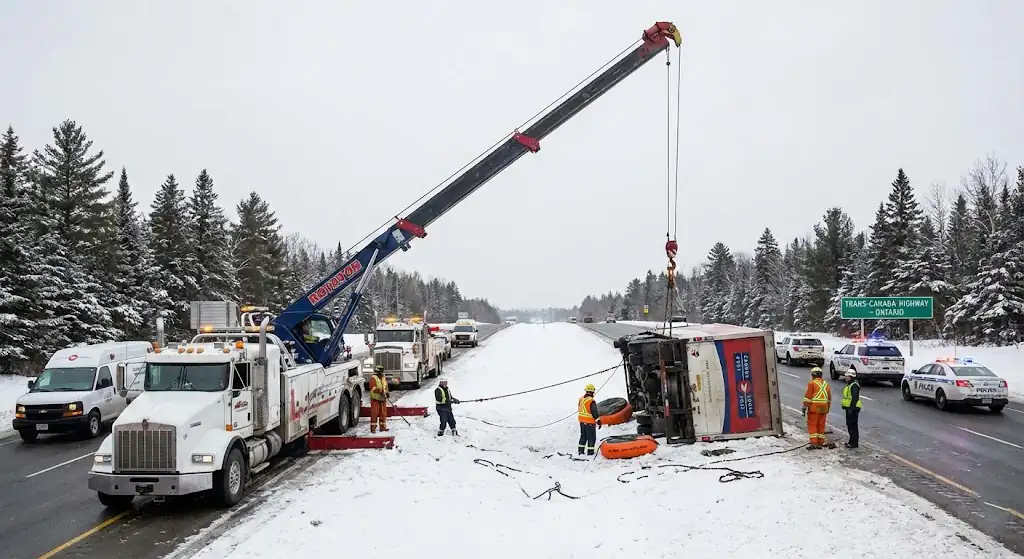
Watch for jackknifing. On icy roads, sudden braking or steering input can cause the trailer to push the tow vehicle sideways, resulting in a jackknife. This is one of the most dangerous trailer incidents — if it happens, you’ll likely need winching and recovery to get both vehicles untangled and back on the road.
What to Do When Your Tow Vehicle Breaks Down with a Trailer
Breaking down while towing a trailer is more complex than a standard vehicle breakdown. Here’s what to do:
Pull completely off the road. With a trailer, you need more shoulder space. Get as far off the highway as possible. If you can reach an exit, parking lot, or wide shoulder, use it. A vehicle-and-trailer combination blocking a lane on the Henday is a serious hazard.
Set up warning markers. Place reflective triangles far behind the trailer — at least 150 metres back on highways. Other drivers need extra warning distance because your combination is much longer than a single vehicle.
Call for heavy-duty towing. A standard tow truck cannot safely move a vehicle that’s attached to a loaded trailer. You need heavy-duty towing equipment that can handle the combined weight. Call Edmonton Towing at (780) 652-0521 — tell our dispatcher that you have a trailer attached and describe the trailer size and load. We’ll send the right equipment.
Don’t try to disconnect the trailer on the shoulder. Unhooking a loaded trailer on the side of a busy highway is dangerous. The trailer can roll, the jack can sink in soft ground, and you’re exposed to passing traffic. Let the professionals handle separation and recovery. For roadside help, see our roadside assistance service.
Common Trailer Towing Mistakes Edmonton Drivers Make
These are the most frequent mistakes we see from Edmonton drivers who run into trouble while towing a trailer:
Overloading. “It’s just a bit over the limit” is the most dangerous phrase in trailer towing. Even 10% over your towing capacity puts extreme stress on your transmission, brakes, tires, and suspension. It’s the leading cause of tow-vehicle breakdowns while hauling.
Not checking the hitch connection. A coupler that isn’t fully seated on the ball can pop off during bumps or sharp turns. Always lift the trailer tongue to verify the coupler is locked, then insert the safety pin. Test it by pulling up on the tongue — it should not lift off the ball.
Ignoring transmission temperature. Towing puts massive strain on your transmission, especially in stop-and-go Edmonton traffic or climbing grades. If your vehicle has a transmission temperature gauge, watch it closely. If it doesn’t, install an aftermarket gauge if you tow regularly. An overheated transmission fails quickly and expensively.
Forgetting the trailer in tight spaces. Edmonton parking lots, gas stations, and drive-throughs are not designed for vehicles with trailers. Know your total length and plan ahead. Making a U-turn or backing into a tight spot with a trailer is when most hitch and body damage occurs.
Skipping wheel bearing maintenance. Trailer wheel bearings need to be repacked with grease annually — more often if you launch boats into water. Seized bearings lock up the wheel, which can cause a tire blowout, fire, or wheel separation at highway speed. If your trailer wheel seizes while driving, you’ll need emergency towing immediately.
Frequently Asked Questions: Towing a Trailer in Edmonton
Do I need a special licence to tow a trailer in Alberta?
A standard Class 5 licence is sufficient for towing most recreational and utility trailers in Alberta. You only need a higher licence class if the combined gross weight of your vehicle and trailer exceeds 11,794 kg, or if you’re towing for commercial purposes that require a Class 1 or 3 licence.
What happens if I break down while towing a trailer on the Henday?
Pull safely onto the shoulder, activate hazard lights, set up reflective triangles, and call Edmonton Towing at (780) 652-0521. Tell us you have a trailer so we can dispatch heavy-duty equipment. Do not attempt to unhook the trailer on a busy highway shoulder.
How much does it cost to tow a vehicle with an attached trailer?
Towing a vehicle-and-trailer combination requires heavy-duty towing and costs more than a standard tow. The price depends on the combined weight, location, and distance. Call (780) 652-0521 for a quote — we provide transparent pricing before dispatch. See our towing rates guide for general pricing.
Can I tow a trailer with an SUV or crossover?
Many SUVs and crossovers can tow trailers, but their capacity is limited compared to trucks. Check your specific vehicle’s towing capacity in the owner’s manual. A Toyota RAV4 can tow around 1,500 kg, while a Chevy Tahoe can handle 3,600+ kg. Never exceed your rated capacity.
What causes trailer sway and how do I fix it?
Trailer sway is usually caused by improper weight distribution (too little tongue weight), crosswinds, excessive speed, or an uneven road surface. If it happens, ease off the gas smoothly, keep the wheel straight, and let the vehicle slow naturally. Installing a weight distribution hitch with sway control prevents most sway issues.
Do I need trailer insurance in Alberta?
Your auto insurance may extend some coverage to the trailer while it’s attached to your vehicle. However, separate trailer insurance is recommended for comprehensive protection — especially for valuable trailers like RVs, boat trailers, and car haulers. Contact your Alberta insurance provider for specific coverage details.
Where can I weigh my trailer in Edmonton?
Several locations in the Edmonton area have public scales including some truck stops, recycling depots, and provincial weigh stations. Knowing your actual trailer weight — not just the estimated weight — is essential for staying within your vehicle’s towing capacity and Alberta’s legal limits.
Can I park a trailer on the street in Edmonton?
Edmonton’s bylaws restrict trailer parking on city streets. Generally, trailers cannot be parked on residential streets for extended periods. Check the City of Edmonton’s parking bylaws for specific rules about your neighbourhood. Violating these rules can result in fines or having your trailer towed.
What if my trailer gets a flat tire on the highway?
Pull over safely and assess the situation. If you have a trailer spare tire and the tools to change it, you can do it yourself — but working on the shoulder of a busy highway is dangerous. If you’re not comfortable or it’s unsafe, call Edmonton Towing at (780) 652-0521. We provide mobile tire change service and can handle trailer tires as well.
Trailer Trouble on the Road?
Heavy-duty towing, recovery, and roadside help for vehicles with trailers.
Edmonton Towing — equipped for the job, any size.