Electric Vehicle Towing Edmonton: What EV Owners Need to Know
⚡ Quick Answer
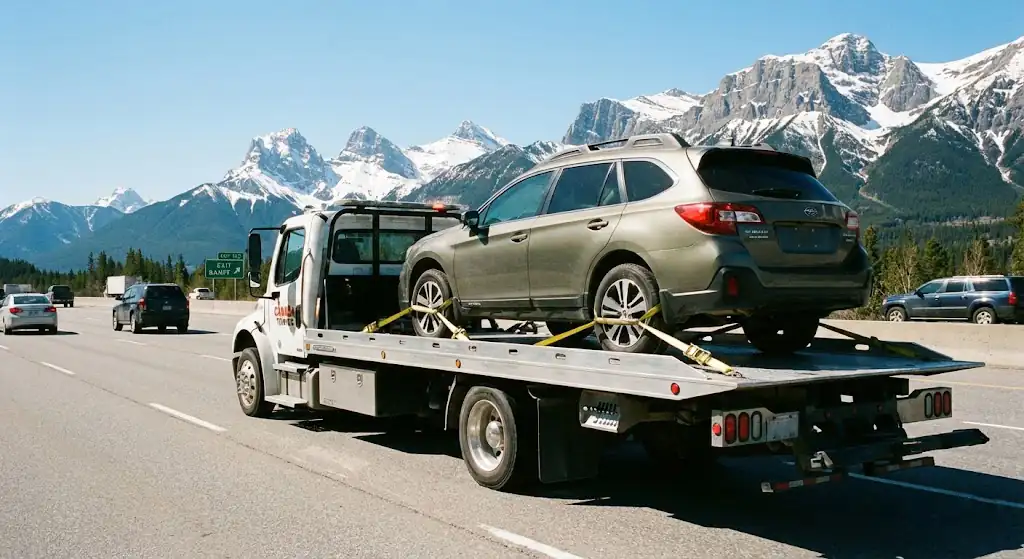
Electric vehicles must be towed on a flatbed tow truck — no exceptions. Towing an EV with its drive wheels on the ground can cause thousands of dollars in damage to the motor, inverter, and battery pack. Electric vehicle towing in Edmonton requires specialized knowledge, and not every tow truck operator knows how to handle EVs safely. Call Edmonton Towing at (780) 652-0521 — we have the flatbed equipment and EV expertise to move your vehicle without damage.
Electric vehicle ownership in Edmonton is growing fast. Alberta saw a 59% increase in battery electric vehicle registrations between 2023 and 2024, and Tesla Model Ys, Model 3s, Kia EV6s, Hyundai Ioniq 5s, and Ford Mustang Mach-Es are becoming a common sight on Edmonton’s roads. But here’s the problem: most EV owners don’t know how their car should be towed — and many tow truck operators don’t either.
Electric vehicle towing in Edmonton is fundamentally different from towing a gas-powered car. The wrong towing method can destroy critical EV components — the electric motor, the inverter, and the battery pack — resulting in repair bills that can exceed $10,000. This isn’t a minor concern; it’s a vehicle-destroying mistake that happens more often than it should.
This guide covers everything Edmonton EV owners need to know about towing their electric vehicle safely: why flatbed towing is mandatory, what can go wrong, how to prepare for a breakdown, and how to choose an EV-capable towing company.
Why Electric Vehicles Need Flatbed Towing
The reason is simple physics. In a traditional gas-powered car, the wheels connect to the engine through a transmission with a neutral gear. When the transmission is in neutral, the wheels spin freely without engaging the engine. You can tow a conventional vehicle on its wheels without much risk.
Electric vehicles don’t work this way. The electric motor is directly connected to the wheels through a single-speed reduction gear. There is no neutral gear that fully disconnects the motor from the wheels. When the wheels of an EV spin — even while being towed — the motor acts as a generator. It creates electricity.
That unregulated electricity has nowhere safe to go. It feeds back into the inverter and battery system, generating extreme heat and causing damage to components that are designed to operate within very specific electrical and thermal parameters.
⚠️ Critical Warning: Towing an electric vehicle with its drive wheels on the ground — using a wheel-lift truck, tow dolly, or hook-and-chain — can cause catastrophic damage to the motor, inverter, and battery pack. This damage is often not covered by warranty if improper towing is documented. Always insist on flatbed towing for any EV.
What Happens If You Tow an EV Wrong
The consequences of improper electric vehicle towing are severe and expensive. Here’s what can happen when an EV is towed with its wheels on the ground:
💡 Pro Tip: Some of this damage is latent — meaning the vehicle may appear to work fine after improper towing but fail days or weeks later under normal driving conditions. The inverter or motor may not throw a warning code immediately, making it hard to connect the damage to the towing incident after the fact. Always use a flatbed tow truck and document everything.
EV Towing Requirements by Vehicle
While the general rule is flatbed towing for all EVs, each manufacturer has specific instructions. Here’s what the most popular EV brands in Edmonton require:
Tesla (Model 3, Model Y, Model S, Model X)
Tesla explicitly requires flatbed towing for all models. The owner’s manual warns that towing with wheels on the ground — even for short distances — can cause severe damage not covered by warranty. Tesla vehicles have a “Transport Mode” that must be activated before loading onto a flatbed to release the parking brake and allow the vehicle to roll freely onto the truck bed.
Hyundai Ioniq 5 / Kia EV6
Both vehicles require flatbed towing. The Hyundai-Kia E-GMP platform does not have a true neutral that disconnects the motor from the wheels. These vehicles are increasingly popular in Edmonton due to their cold-weather performance and available all-wheel-drive.
Ford Mustang Mach-E / F-150 Lightning
Ford recommends flatbed towing for both EVs. The F-150 Lightning is becoming common in Edmonton — especially among tradespeople switching from gas trucks — and requires specific loading procedures due to its weight (over 6,000 lbs).
Nissan Leaf / Chevrolet Bolt
Both are front-wheel-drive EVs that must be flatbed-towed. The Leaf has been in production long enough that many used models are on Edmonton roads — and their owners may not be aware of the flatbed requirement, especially if they previously owned gas vehicles.
Plug-In Hybrids (PHEV)
Plug-in hybrids like the Toyota RAV4 Prime, Mitsubishi Outlander PHEV, and BMW X3 30e have both electric motors and gas engines. These are more complex to tow because the towing method depends on the drivetrain configuration. As a general rule, always consult your owner’s manual. When in doubt, flatbed towing is always the safest option.
EV Towing Done Right. Every Time.
Edmonton Towing has the flatbed equipment and EV knowledge to protect your vehicle.
How Flatbed Towing Works for Electric Vehicles
The flatbed towing process for an EV follows specific steps that differ from towing a conventional vehicle. Here’s what a qualified tow truck operator does:
Assess the vehicle and situation. The operator identifies the EV model, checks for damage, and determines the safest approach. For accident recovery, they also check for battery damage — compromised EV batteries can be a fire hazard.
Activate Transport Mode (if available). Many EVs — including all Teslas — have a Transport Mode that releases the electronic parking brake and allows the wheels to roll freely. This is essential for loading the vehicle onto the flatbed without damage. The tow operator or the EV owner needs to activate this through the vehicle’s touchscreen or app.
Position the flatbed and load the vehicle. The flatbed tilts or slides to ground level. The EV is carefully driven or winched onto the bed. Proper positioning is important — EVs have heavy battery packs low in the chassis, which affects the vehicle’s centre of gravity during transport.
Secure with proper tie-down points. EVs have specific tow points and tie-down locations. Using incorrect anchor points — especially near battery enclosures — can cause structural damage or compromise battery safety. The operator uses wheel straps and the manufacturer’s recommended tie-down locations.
Transport to the destination. The EV rides safely on the flatbed with all four wheels off the ground. No regenerative braking, no motor spinning, no electrical damage. The vehicle arrives at the repair shop or dealership in the same condition it was picked up.
EV Breakdown Scenarios in Edmonton
Electric vehicles break down differently than gas cars. Here are the most common EV breakdown scenarios Edmonton drivers face and how to handle each one:
Dead Battery / Out of Charge
The most common EV breakdown is running out of charge. Edmonton’s cold winters drain EV batteries faster than expected — range can drop 30 to 40% in extreme cold. If your EV dies on the side of the road with no charge, you need a flatbed tow to the nearest charging station or dealership. There’s no EV equivalent of a jerry can of gas — you can’t carry a few kilowatt-hours in the trunk.
Flat Tire
Most new EVs don’t come with a spare tire — manufacturers eliminated them to save weight and maximize range. If you get a flat tire in Edmonton, you’ll need either a mobile tire repair service or a flatbed tow to a tire shop. EV tires are also different — they’re typically lower rolling resistance and may not be stocked at every shop.
12V Battery Failure
Even though EVs have large high-voltage battery packs, they also have a small 12V battery that powers accessories, locks, and the computer systems. When this 12V battery dies, the EV won’t start — even if the main battery is fully charged. A battery boost service can sometimes resolve this, but many EV 12V batteries are lithium-ion and require specific handling.
Software or Electrical Malfunction
EVs are highly computerized. A software glitch, sensor failure, or electrical fault can immobilize the vehicle even if the battery and motor are fine. When the vehicle won’t move or won’t come out of Park, flatbed towing to a certified EV repair centre or dealership is the only option.
Collision / Accident Damage
After any collision involving an EV, the battery must be inspected for damage. Even minor impacts can compromise the battery enclosure, creating potential fire or chemical hazard risks. Post-accident EV towing requires flatbed transport and should only be handled by operators who understand EV battery safety. Learn more about accident towing in Edmonton.
EV Towing Costs in Edmonton
Electric vehicle towing in Edmonton typically costs more than standard towing because flatbed trucks are required. Here’s a general cost breakdown:
Many EV manufacturers include complimentary roadside assistance for the first few years — Tesla, Hyundai, Kia, and Ford all offer this. Check your EV’s warranty to see if towing is covered. Your auto insurance policy may also include towing coverage. For full pricing details, visit our Edmonton tow truck cost guide.
How to Prepare Your EV for a Potential Towing Situation
Edmonton’s winters and the growing but still limited EV charging network mean breakdowns are a reality for EV owners. Here’s how to prepare:
Know your vehicle’s Transport Mode. Before you need a tow, learn how to activate Transport Mode (or the equivalent) in your specific EV. Practice it in your driveway. When you’re stranded on the Whitemud at -25°C, you don’t want to be searching through your owner’s manual.
Save a flatbed tow truck number. Not every towing company has flatbed trucks available, and not every operator knows how to handle an EV. Save Edmonton Towing’s number — (780) 652-0521 — in your phone contacts. Specify that you drive an EV when you call so we dispatch the right equipment.
Keep your charge above 20%. Edmonton’s cold weather can drain your battery faster than expected. Keeping your charge above 20% gives you a buffer against unexpected range loss from cold temperatures, detours, or traffic.
Know where the tow points are. Your EV’s tow hook points are in specific locations — usually behind small covers in the front and rear bumpers. Find them on your vehicle and know how to access them. This speeds up the loading process when the flatbed arrives.
Carry a portable 12V charger or jumper. Since the 12V battery is a common failure point, a small portable 12V jump pack can get you running again without a tow in many situations. Learn more in our jump start guide.
Choosing an EV-Capable Towing Company in Edmonton
Not all towing companies are equipped to handle electric vehicles safely. When choosing an EV towing service in Edmonton, look for these qualifications:
Flatbed availability. The company must have flatbed tow trucks — not just wheel-lift trucks. Confirm this when you call. If they offer to send a wheel-lift truck for your EV, find a different company.
EV handling experience. Ask if their operators have experience loading and transporting EVs. Do they know about Transport Mode? Do they know where the tow points are? An inexperienced operator can damage your vehicle during loading.
Proper insurance. Make sure the towing company carries adequate insurance to cover EV damage during transport. EVs are expensive vehicles — if something goes wrong, you need to know you’re covered.
Transparent pricing. Get a clear quote before the truck arrives. Edmonton Towing provides upfront pricing with no hidden fees. For more on what to look for, read our guide: How to Choose a Towing Company in Edmonton: 7 Red Flags to Avoid.
Frequently Asked Questions: EV Towing in Edmonton
Can you tow an electric car with a regular tow truck?
No. Electric vehicles should never be towed with a wheel-lift or hook-and-chain tow truck. EVs require a flatbed tow truck that keeps all four wheels off the ground. Towing an EV with its drive wheels on the road causes the electric motor to spin and generate uncontrolled electricity, damaging the motor, inverter, and battery pack.
How much does it cost to tow a Tesla in Edmonton?
Flatbed towing for a Tesla in Edmonton typically costs between $125 and $200+ depending on distance and time of day. Tesla includes complimentary roadside assistance for the first four years or 80,000 km, which may cover towing costs. Call Edmonton Towing at (780) 652-0521 for an exact quote.
What is Transport Mode on an electric vehicle?
Transport Mode is a setting in many EVs (especially Teslas) that releases the electronic parking brake and allows the wheels to roll freely for loading onto a flatbed. It does not put the vehicle in “neutral” for road towing — it specifically enables safe flatbed loading only. Check your owner’s manual for how to activate it on your specific model.
What happens if my EV runs out of charge in Edmonton?
If your EV runs out of charge, you’ll need a flatbed tow to the nearest charging station or to your home. Unlike running out of gas, there’s no mobile charging service available yet in Edmonton. Keep your charge above 20%, especially in winter when cold temperatures reduce range significantly.
Does insurance cover EV towing in Alberta?
Many Alberta auto insurance policies include towing coverage, which applies to EVs the same as gas vehicles. Additionally, most EV manufacturers include complimentary roadside assistance for the first few years. Check both your insurance policy and your EV warranty to understand your coverage.
Can I flat-tow my EV behind an RV or motorhome?
No. Electric vehicles cannot be flat-towed (towed with all four wheels on the ground behind another vehicle). The same regeneration problem applies — the wheels spinning the motor creates uncontrolled electricity and heat. If you need to transport your EV alongside a motorhome, use a car hauler trailer.
Is EV towing available 24/7 in Edmonton?
Yes. Edmonton Towing provides 24-hour flatbed towing for electric vehicles. EV breakdowns don’t follow business hours — dead batteries, flat tires, and software glitches can happen at any time. Call (780) 652-0521 day or night.
Do hybrid vehicles also need flatbed towing?
It depends on the hybrid type. Plug-in hybrids (PHEVs) with electric-only drive modes should generally be flatbed-towed. Standard hybrids (like the Toyota Corolla Hybrid) that use the gas engine as the primary drive may be okay with conventional towing in some configurations. Always consult your owner’s manual or call us at (780) 652-0521 — we’ll advise on the safest method for your specific vehicle.
What should I tell the tow truck dispatcher when I call about my EV?
Tell them: (1) Your vehicle is electric or a plug-in hybrid, (2) The make and model, (3) You need a flatbed — not a wheel-lift, (4) Whether you can activate Transport Mode or if the vehicle is completely dead. This information ensures the right equipment is dispatched on the first attempt.
Where can I get my EV repaired in Edmonton after a tow?
Edmonton has several certified EV service centres including Tesla’s service facility, Hyundai and Kia dealerships with EV-certified technicians, and Ford dealers with Lightning/Mach-E training. When you call Edmonton Towing, we can transport your vehicle to whichever facility you choose — just provide the address and we’ll deliver it there.
Edmonton’s EV Towing Experts
Flatbed towing for every electric vehicle. Handled with care.
Tesla, Hyundai, Kia, Ford, Nissan, Chevrolet — we tow them all safely.